



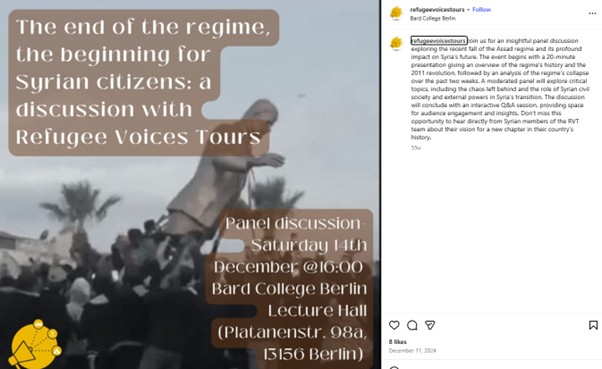
The Refugee Voices Tours initiative in Germany offers a well-documented example of refugee-led, educational walking tours that explore migration, memory, and belonging through lived experience. Based in Berlin, the project enables refugees — including Syrians — to guide visitors through historically significant parts of the city while sharing personal stories of displacement, survival, and integration.
Refugee Voices was established to address public misunderstanding around migration by allowing refugees to speak for themselves. As the organisation explains, the project aims to challenge stereotypes by creating direct, human encounters between refugees and the public. https://refugeevoicestours.com/
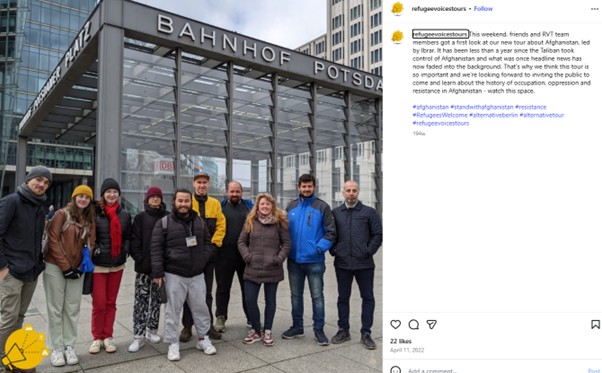
What the Tours Involve (Fact-Based)
Participants join guided walking tours in Berlin that move through areas shaped by conflict, division, and memory — including locations near the former Berlin Wall and major historical institutions. Along the route, guides combine:
- Historical context about Berlin’s 20th-century past
- Personal accounts of forced migration and arrival in Germany
- Reflections on identity, loss, resilience, and rebuilding life after conflict
One of the tours, “Why We Are Here,” explicitly focuses on explaining the causes of migration and displacement from the perspective of those who experienced it directly. Refugee Voices guides have spoken publicly about drawing comparisons between historical trauma in Germany and contemporary conflicts, not to equate them, but to help visitors understand how societies recover after violence and authoritarianism.
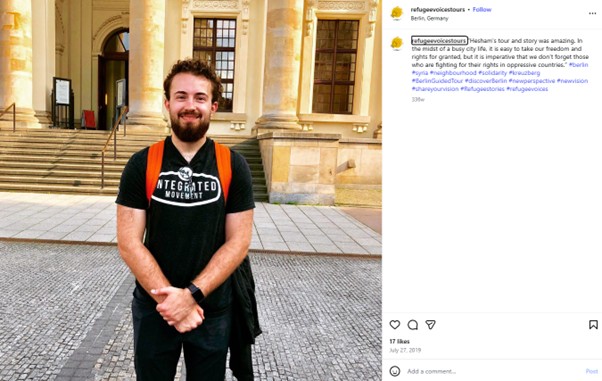
Migration from Syria to Germany
Germany received a significant number of asylum seekers during the 2015 refugee crisis. According to the German Federal Office for Migration and Refugees (BAMF):
- Over 1 million refugees arrived in Germany in 2015
- Syrians constituted the largest single nationality group
https://www.bamf.de/EN/Themen/Statistik/Asylzahlen/asylzahlen-node.html
This context is frequently referenced during Refugee Voices tours to help visitors situate individual stories within broader historical and political realities.
Refugee-Led Dialogue and Empathy
Public interviews and media coverage of Refugee Voices emphasise that the tours are designed to create dialogue rather than pity, and understanding rather than fear. Guides consistently highlight that personal interaction is key to reducing “othering.”
As one Refugee Voices guide explained in interviews with German and international media, when people understand why refugees were forced to leave and what shaped their journey, attitudes often change. This approach aligns with recognised best practice in intercultural education and non-formal learning.
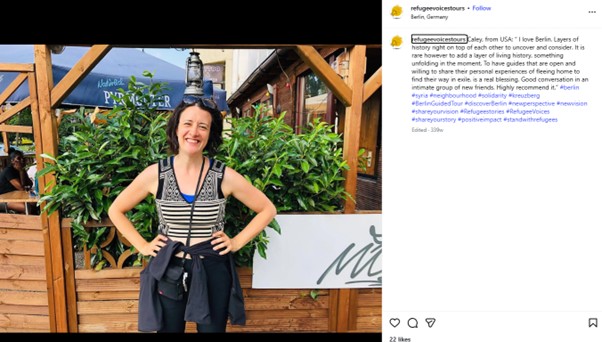
Examples of media coverage:
- Deutsche Welle (DW): Refugee-led walking tours in Berlin
https://www.dw.com/en/refugees-guide-berlin-walking-tours/a-45674752
- The Guardian: Refugees as cultural guides
https://www.theguardian.com/world/2017/sep/03/refugees-berlin-walking-tours

Why This Model Matters for European Countries
Although Refugee Voices is based in Germany, the model resonates strongly with the European context. Europe’s peacebuilding and tourism landscape has increasingly focused on:
- Giving voice to lived experience
- Addressing contested or sensitive histories
- Supporting dialogue in increasingly diverse communities
Some European countries are also experiencing growing cultural diversity through migration, resettlement, and asylum programmes. As a result, questions around integration, representation, and belonging are becoming more visible in European public life.
Projects like Refugee Voices demonstrate one way that tourism and storytelling can support understanding, without exploiting trauma or simplifying complex histories.
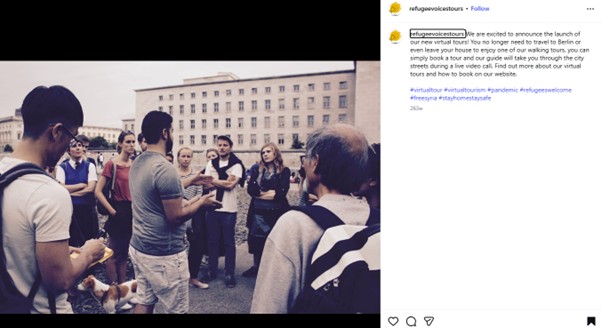
Refugee is a Great Example Informing Paths to Peace (P2P)
Paths to Peace learns from and references Refugee Voices initiatives as part of its wider research and training framework. Within P2P, Refugee Voices functions as:
- An external case study of refugee-led tourism
- A reference point for youth-focused peace tourism models
- An example of how lived experience can be ethically integrated into visitor learning
As outlined on the Paths to Peace website, the project seeks to:
“Equip young people with tools to promote peace through tourism, dialogue, and local action.” https://pathstopeace.eu/
What Europe Can Learn and Apply
Using the P2P framework, European countries could explore and/or replicate similar approaches by:
- Supporting migrant-led storytelling initiatives in cities
- Creating co-led tours involving migrants and local youth in educational settings
- Integrating intercultural dialogue into existing heritage or civic tourism offers
- Using non-formal education to prepare young people to facilitate sensitive conversations
These would be future-facing applications, developed responsibly with local communities and migrant organisations.
Learning Beyond Borders
Refugee Voices Tours illustrate that:
- Stories of displacement and rebuilding are not unique to one country
- Dialogue works best when people speak for themselves
- Tourism can be educational without being extractive
For other European Countries, and for Paths to Peace, this reinforces a central lesson: peacebuilding is not only about the past, but about how societies respond to change in the present.
By sharing learning across borders — between Germany, Ireland, and other partner countries — Paths to Peace helps young people can understand how tourism, when designed ethically, can support social cohesion and mutual understanding in diverse societies.
Written by:
Laura Magan,
European Projects Specialist in Tourism,
Momentum,
Ireland
Sources & References
Refugee Voices Tours – Official Website
https://refugeevoicestours.com/
Refugee Voices Tours – “Why We Are Here” Tour
https://refugeevoicestours.com/tours/
Deutsche Welle (DW) – Refugees guide walking tours through Berlin
https://www.dw.com/en/refugees-guide-berlin-walking-tours/a-45674752
The Guardian – Refugees offer walking tours of Berlin to share their stories
https://www.theguardian.com/world/2017/sep/03/refugees-berlin-walking-tours
German Federal Office for Migration and Refugees (BAMF) – Asylum Statistics
https://www.bamf.de/EN/Themen/Statistik/Asylzahlen/asylzahlen-node.html
UNHCR – Germany Refugee Response
https://www.unhcr.org/countries/germany
Berlin Wall Foundation – History & Memorial Sites
https://www.berliner-mauer-gedenkstaette.de/en
Topography of Terror Foundation – Documentation Centre
https://www.topographie.de/en/